
Cold Storage for Healthcare in Tanzania – The Critical Upgrade
Bottom Line
If Tanzania wants to improve healthcare outcomes, protect medical supplies and strengthen system resilience, it must invest in reliable cold storage. With over 12,800 healthcare facilities across the country and documented gaps in service delivery, infrastructure remains under pressure.
Cold storage directly improves vaccine integrity, pharmaceutical quality and overall healthcare efficiency while reducing costly losses.
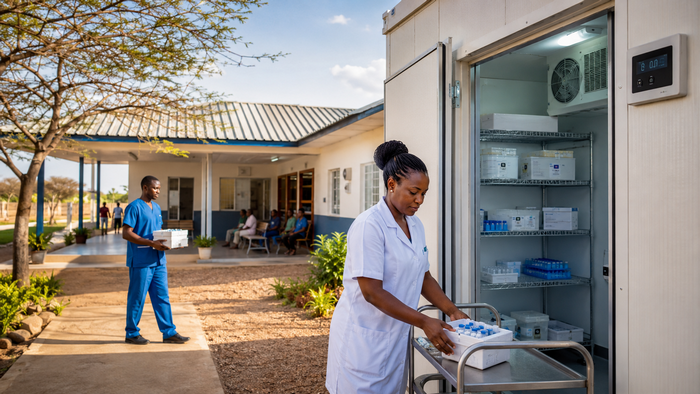
Table of Contents
- Why Healthcare Infrastructure Matters in Tanzania
- The Real Challenges Facing Tanzania’s Health System
- The Cold Chain Gap in Healthcare Infrastructure
- Why Cold Storage Is Essential for Tanzania’s Healthcare
- How We Engineer High-Performance Modular Cold Storage
- Our Cold Room and Freezer Room Solutions for Healthcare
- Economic Impact of Strengthening Healthcare Infrastructure
- Future Opportunities in Tanzania’s Healthcare Sector
- Frequently Asked Questions
- Take Action: Strengthen Your Healthcare Infrastructure
Why Healthcare Infrastructure Matters in Tanzania
Tanzania’s healthcare system is expanding. Recent data shows there are 12,846 health facilities across the country, forming the backbone of national service delivery.
But scale alone does not guarantee performance.
A recent health sector report highlights this clearly: “This report presents the progress, status, and gaps in delivering quality and standard health care services for all in 2024.”
That single line tells the full story. Progress exists. But gaps remain. Cold storage sits at the centre of those gaps.
The Real Challenges Facing Tanzania’s Health System
Tanzania’s healthcare infrastructure faces multiple interconnected challenges.
Infrastructure and Capacity Gaps
Facilities exist, but not all are fully equipped. Storage systems, laboratories and supply chains are still being strengthened.
Supply Chain Constraints
Medical supplies must move across large geographic areas. Without proper storage, quality can deteriorate before reaching patients.
Cold Chain Limitations
Immunisation programmes and pharmaceutical systems rely on stable temperature environments. Reports highlight stockouts and equipment maintenance challenges, especially in remote facilities.
System Pressure from Public Health Events
Recent public health challenges have placed additional strain on infrastructure, affecting both healthcare delivery and broader economic stability. These are not isolated issues. They are structural challenges that require infrastructure solutions.
The Cold Chain Gap in Healthcare Infrastructure
Healthcare depends on temperature control. Vaccines, medicines, blood products and laboratory reagents all require stable environments.
Without reliable cold storage:
- Vaccines lose potency
- Medicines degrade
- Laboratory results become unreliable
- Inventory losses increase.
Cold chain gaps are not visible to patients. But their impact is immediate. Cold storage bridges this gap.
Why Cold Storage for Health Care Tanzania Is Essential
Cold storage is not an upgrade. It is core infrastructure.
Vaccine Protection
Cold rooms operating between 2 and 5°C maintain vaccine effectiveness from central storage to local clinics.
Pharmaceutical Stability
Temperature-sensitive medicines require controlled environments to remain safe and effective.
Blood and Plasma Storage
Cold rooms protect critical blood products.
Laboratory Accuracy
Diagnostic materials require stable environments to ensure reliable results.
Emergency Preparedness
Healthcare systems must scale quickly during outbreaks. Modular cold storage allows rapid expansion without long delays.
Cold storage strengthens every level of the system.
How We Engineer High-Performance Modular Cold Storage
At Africhill, we do not just build cold rooms. We engineer high-performance cold storage solutions designed for maximum durability and efficiency.
Every solution is designed around:
- Your product type
- Storage mass
- Required temperature
- Daily throughput
- Pull-down time
- Ambient conditions
This ensures your system performs exactly as required.
Strong, Thermal Resistant Panels
Our panels are manufactured in-house using high-density EPS cores bonded to Chromadek steel. This provides excellent insulation, structural durability, long-term reliability, and minimal maintenance.
Fast Deployment
A 9 m x 9 m modular cold or freezer room can be operational in approximately 3 days. This is critical for healthcare expansion projects.
Energy Efficiency
Our insulated panels reduce electricity consumption, helping healthcare facilities manage operational costs.
Clean and Safe Installation
Our modular construction is neater, quieter and safer, reducing disruption in clinical environments.
Our Cold Room and Freezer Room Solutions for Healthcare
We provide fully customised solutions for Tanzania’s healthcare sector. We offer end-to-end installation or DIY solutions depending on your operational requirements.
Economic Impact of Strengthening Healthcare Infrastructure
Healthcare infrastructure is directly linked to economic performance.
Reduced Losses
Reliable storage prevents wastage of vaccines and medicines.
Improved Service Delivery
Stable systems increase efficiency and reduce disruptions.
Economic Stability
Health system resilience supports productivity and reduces long-term costs.
Reduced National Losses
Infrastructure improvements across sectors have been linked to billions in potential economic savings.
Cold storage strengthens both healthcare and the economy.
Future Opportunities in Tanzania’s Healthcare Sector
Tanzania continues to invest in healthcare infrastructure.
Opportunities include expansion of regional hospitals, growth in laboratory capacity, strengthening immunisation systems, and improved medical supply chains.
Cold storage is central to all of these developments.
Modular cold rooms and freezer rooms provide scalable infrastructure that supports long-term growth.
Frequently Asked Questions
Why is cold storage important in healthcare?
It ensures vaccines, medicines and medical supplies remain effective and safe.
What temperature is required for medical cold storage?
Cold rooms operate between 2 and 5°C, while freezer rooms operate between -18 and -20°C.
How quickly can a cold room be installed?
A modular cold room can be operational in approximately 3 days.
Can cold storage reduce healthcare costs?
Yes. It reduces wastage and improves operational efficiency.
Does Africhill deliver to Tanzania?
Yes. We deliver across Sub-Saharan Africa.
Take Action: Strengthen Your Healthcare Infrastructure
Tanzania’s healthcare system is growing. But without reliable infrastructure, growth alone is not enough.
Cold storage for health care Tanzania is the key to protecting medical supplies, improving service delivery and strengthening system resilience.
We engineer modular cold rooms and freezer rooms tailored to your exact needs. We manufacture our own panels. We deliver across Africa. We build fast. We build to last.
If you are serious about improving healthcare infrastructure, now is the time to act.
Complete the enquiry form and let us design a cold storage solution that supports your facility, your patients and your future.
Sources Consulted:
Tanzania Health Facility Atlas 2024
Publisher: Ministry of Health, United Republic of Tanzania
Summary: This atlas provides a current overview of Tanzania’s health infrastructure and reports an extensive national network of 12,846 health facilities. It is highly useful for establishing the scale of the healthcare system and the infrastructure footprint that must be supported by reliable cold storage, blood bank capacity and medical supply systems.
https://www.moh.go.tz/storage/app/uploads/public/698/4e8/d38/6984e8d3896fb680900170.pdf
Annual Health Sector Performance Profile 2024
Publisher: Ministry of Health, United Republic of Tanzania
Summary: This official report summarises the progress, status and gaps in delivering quality health services in 2024. It is one of the best sources for framing current healthcare infrastructure challenges because it explicitly focuses on performance gaps and evidence-based action areas across the health system.
https://www.moh.go.tz/storage/app/uploads/public/698/337/ef7/698337ef72583788742967.pdf
Universal Health and Preparedness Review National Report of the United Republic of Tanzania
UHPR National Report Tanzania 2025
Publisher: World Health Organization
Summary: This WHO national report is highly relevant for showing that recent public health emergencies have strained Tanzania’s healthcare systems and affected the country’s broader economic and social structure. It supports a strong resilience angle for healthcare infrastructure and makes a solid case for strengthening systems that protect temperature-sensitive medical products.
https://cdn.who.int/media/docs/default-source/health-security-preparedness/uhpr/uhpr-national–report_tanzania-2025.pdf
Ministry of Health Medium Term Strategic Plan 2021/22–2025/26
Medium Term Strategic Plan 2021/22–2025/26
Publisher: Ministry of Health, United Republic of Tanzania
Summary: This plan remains within your 3-year requirement and is valuable because it documents concrete infrastructure and system constraints, including inadequate staff numbers and skills, inadequate ICT infrastructure, fragmented systems, and the continued need to construct and complete regional satellite blood banks and hospital rehabilitation. Those details create a strong infrastructure gap narrative for healthcare cold storage.
https://www.moh.go.tz/storage/app/uploads/public/687/9f6/3fa/6879f63fad8f2963963184.pdf
Analysis and Documentation of Pro-Equity Immunization
UNICEF Zero-Dose Immunization ESA Report 2023
Publisher: UNICEF Eastern and Southern Africa Regional Office
Summary: This report is valuable because it includes Tanzania-specific immunization equity findings. It notes that Tanzania’s 2022 immunization-equity assessment found monthly stockouts in a share of facilities and also identified inadequate spare parts for cold chain equipment maintenance and standby power-related components. It is one of the best recent sources for supporting a vaccine cold-chain infrastructure argument.
https://www.unicef.org/esa/media/15806/file/UNICEF-Zero-Dose-ESA-Report-2023.pdf
United Republic of Tanzania Country Climate and Development Report
Country Climate and Development Report
Publisher: The World Bank
Summary: This report is useful for the economic impact angle. It states that supporting universal WASH access could reduce Tanzania’s annual economic losses by $1.9 billion by 2030 and argues that adaptive health delivery will require climate-resilient infrastructure design. This gives you a strong macroeconomic bridge between infrastructure investment and national resilience.
https://documents1.worldbank.org/curated/en/099121124114037812/pdf/P180187-9ca6fecb-851a-4b55-96f6-197ef868e127.pdf
World Bank Implementation Status and Results Report
Tanzania Maternal and Child Health Investment Program and Additional Financing
Publisher: The World Bank
Summary: This implementation report is helpful for showing that health infrastructure improvement remains an active national investment area. It references improved health infrastructure, support for zonal blood bank and blood transfusion services, and procurement of medical equipment and essential commodities for target facilities. It supports the argument that storage and support systems remain part of ongoing health system strengthening.
https://documents1.worldbank.org/curated/en/099101024072591035/pdf/P170435-e26ae5cf-2e8f-4375-86bb-b1588658ed8e.pdf