
Cold Storage Unlocks Productivity and Food Security for Tanzania’s Agriculture
Bottom Line
If Tanzania wants to improve agricultural productivity and strengthen food security, it must invest in reliable, engineered cold storage. A large share of produce is still sold unprocessed, irrigation remains limited, and post-harvest losses continue to reduce farmer income and national food supply.
Cold storage is not just an upgrade for agriculture Tanzania. It is essential infrastructure that protects value, reduces waste and stabilises the entire food system.
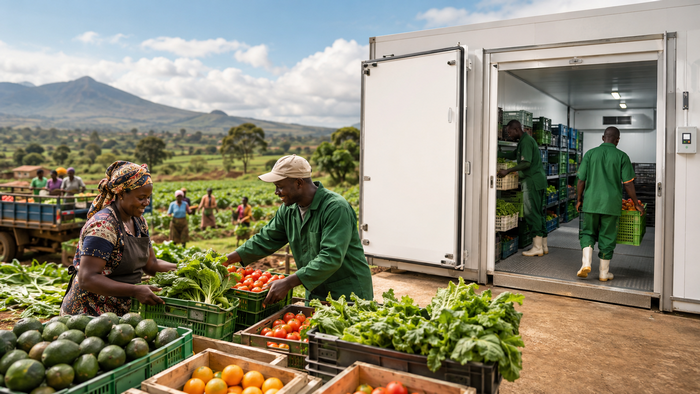
Table of Contents
- Why Agricultural Productivity and Food Security Matter in Tanzania
- The Real Challenges Holding Tanzania Back
- The Cold Storage Gap in Tanzania’s Agricultural System
- Why Cold Storage for Agriculture Tanzania Is a Strategic Solution
- How We Engineer High-Performance Modular Cold Storage
- Our Cold Room and Freezer Room Solutions for Agriculture
- Experience Matters Across African Agriculture
- Economic Impact of Cold Storage on Tanzania’s Economy
- Future Opportunities for Tanzania’s Agricultural Growth
- Frequently Asked Questions
- Take Action: Strengthen Your Cold Chain Today
Why Agricultural Productivity and Food Security Matter in Tanzania
Agriculture is one of the most important sectors in Tanzania’s economy. It supports livelihoods, drives food supply and contributes to economic stability.
Yet recent data shows clear inefficiencies. Only 4.3 percent of planted land is irrigated, and adoption of improved seeds remains uneven. Even more critical, a large share of produce is still sold unprocessed. In some cases, over 80 percent of crops like avocados and oranges are sold without processing or preservation.
This creates a simple problem. When produce is not preserved, it deteriorates. When it deteriorates, value is lost.
This is where cold storage for agriculture Tanzania becomes essential.
The Real Challenges Holding Tanzania Back
Tanzania’s agricultural system faces structural challenges that limit productivity and food security.
Limited Irrigation and Climate Dependence
With only a small percentage of land irrigated, production remains highly dependent on rainfall. This leads to inconsistent supply and seasonal gluts.
Post-Harvest Losses
Produce often moves from farm to market without temperature control. Heat exposure reduces quality and shortens shelf life.
Weak Value Addition
Most produce is sold raw. Without storage or processing, farmers are forced to sell quickly, often at lower prices.
Market Access Constraints
Farmers in rural areas struggle to store and transport produce to higher-value markets.
These challenges are not isolated, they are connected. Without proper storage, productivity gains are lost before products reach the market.
The Cold Storage Gap in Tanzania’s Agricultural System
Storage infrastructure plays a central role in food security.
As stated in Tanzania’s agricultural policy framework: “The food storage facilities play a vital role in protecting food crops, thereby reducing the qualitative and quantitative post-harvest losses.”
Despite this, cold storage remains limited across much of the agricultural value chain.
The result is predictable:
- Fresh produce spoils before reaching markets
- Farmers lose income
- Supply becomes unstable
- Food prices fluctuate
Cold storage is the missing link between production and profitability.
Why Cold Storage for Agriculture Tanzania Is a Strategic Solution
Cold storage transforms how agricultural systems function.
Extends Shelf Life
Cold rooms operating between 2 and 5°C preserve fresh produce, dairy and perishable goods.
Protects High-Value Products
Freezer rooms operating between -18 and -20°C protect meat, fish and processed goods.
Reduces Waste
Stable temperatures reduce spoilage and improve product quality.
Enables Market Timing
Farmers and distributors can store products and sell when prices are favourable.
Supports Aggregation and Distribution
Cold storage allows collection and consolidation of produce for larger markets.
Cold storage for agriculture in Tanzania is not just about refrigeration. It is about control.
How We Engineer High-Performance Modular Cold Storage
At Africhill, we do not just build cold rooms. We engineer high-performance cold storage solutions designed for maximum durability and efficiency.
Every solution is designed around:
- Your product type
- Storage mass
- Required temperature
- Daily throughput
- Pull-down time
- Ambient conditions
This ensures your system performs exactly as required.
Strong, Thermal Resistant Panels
Our panels are manufactured in-house using high-density EPS cores bonded to Alu-Zink steel. This provides excellent insulation, structural durability, long-term reliability and minimal maintenance.
Fast Deployment
A 9 m x 9 m modular cold or freezer room can be operational in approximately 3 days. This allows you to scale quickly and minimise downtime.
Energy Efficiency
Our insulated panels reduce electricity consumption, helping you control operational costs.
Clean and Safe Installation
Our modular construction is neater, quieter and safer, reducing disruption during installation.
Fully Customised Modular Cold Storage Solution
We offer fully customised modular cold storage solutions tailored to Tanzania’s agricultural sector.
Full Solution or DIY
We offer end-to-end solutions or DIY installation depending on your operational needs.
Experience Matters Across African Agriculture
For over 25 years, we have delivered modular cold storage solutions across Africa, from fruit cold storage installations in Angola and dairy cold storage projects in Zimbabwe, to agricultural and food storage solutions across multiple African markets.
These environments demand reliability, durability and performance under pressure. We bring that experience into every project.
Economic Impact of Cold Storage on Tanzania’s Economy
Improving agricultural productivity has a direct impact on the economy.
Reduced Post-Harvest Loss
Less spoilage means more sellable product.
Increased Farmer Income
Farmers can store and sell at better prices.
Stable Food Supply
Better storage reduces seasonal shortages.
Lower Inflation Pressure
Improved food supply supports price stability.
Cold storage strengthens the entire agricultural value chain.
Future Opportunities for Tanzania’s Agricultural Growth
Tanzania is investing in food systems resilience and agricultural development. Opportunities include expansion of horticulture exports, growth in dairy and livestock sectors, development of aggregation hubs, and improved regional trade.
Cold storage is central to all of these opportunities. Modular cold rooms and freezer rooms provide scalable infrastructure that grows with demand.
Frequently Asked Questions
Why is cold storage important for agriculture in Tanzania?
Cold storage reduces post-harvest losses, preserves quality and improves market access for farmers.
What temperature should agricultural cold storage operate at?
Cold rooms typically operate between 2 and 5°C, while freezer rooms operate between -18 and -20°C.
How quickly can a cold room be installed?
A 9 m x 9 m modular cold room can be operational in approximately 3 days.
Can cold storage improve farmer income?
Yes. It allows farmers to store produce and sell at better prices, reducing forced sales.
Does Africhill deliver to Tanzania?
Yes. We deliver modular cold and freezer rooms across Sub-Saharan Africa.
Take Action: Strengthen Your Cold Chain Today
Tanzania’s agricultural sector has the potential to grow. But without reliable storage, that potential is lost.
Cold storage for agriculture Tanzania is the key to reducing waste, improving productivity and strengthening food security.
We engineer modular cold rooms and freezer rooms designed for your specific needs. We manufacture our own panels. We deliver across Africa. We build fast. We build to last.
If you are serious about protecting your produce and growing your operation, now is the time to act.
Complete the enquiry form and let us design a cold storage solution that works for your business.
Sources Consulted:
Annual Agricultural Sample Survey 2023/24 Key Findings Report
Author: National Bureau of Statistics, Tanzania
Short summary: This is the strongest recent statistical snapshot for Tanzania’s farm-level productivity constraints. It shows low irrigation coverage, uneven adoption of improved seeds, and high volumes of fruit and vegetable output being sold unprocessed, all of which strengthen the case for cold storage, aggregation and value preservation.
Link: https://www.nbs.go.tz/uploads/statistics/documents/en-1760643333-KEY%20FINDINGS%20REPORT_AASS%202023-24_ENGLISH.pdf
Public Warehouses Utilization Guideline, 2025
Author: Ministry of Agriculture, United Republic of Tanzania
Short summary: This is one of the most directly relevant government documents for your angle. It explicitly states that food storage facilities reduce qualitative and quantitative post-harvest losses, improve food and nutrition security, support stable food supply, enhance agricultural trade and can help lower inflationary pressure in the economy.
Link: https://faolex.fao.org/docs/pdf/tan237659.pdf
Tanzania Economic Update: Harnessing the Opportunity for a Climate-Smart and Competitive Livestock Sector in Tanzania
Author: The World Bank
Short summary: This report links agricultural productivity to macroeconomic stability and shows why agriculture remains economically strategic. It notes that efforts to increase agricultural productivity and food supply are expected to support low and stable inflation, and it highlights the scale and low-productivity challenge of Tanzania’s livestock subsector.
Link: https://documents1.worldbank.org/curated/en/099081524060016951/pdf/P17961019db2eb013193781c2280fd79237.pdf
Agriculture and Fisheries Development Programme: Supervision Report, January 2025
Author: International Fund for Agricultural Development
Short summary: This report is useful for showing where Tanzania is actively investing to reduce post-harvest losses and improve value addition. It highlights infrastructure and technologies aimed at reducing post-harvest losses in fisheries, including processing plants, ice-making facilities, dryers and other post-harvest systems.
Link: https://www.ifad.org/documents/48415603/50532614/TZA_2000001519_SUPERVISION_REPORT_JAN_2025_0014-161716620-8123.pdf/bd98bc83-f0d0-0475-4f65-caa91ef18074?t=1737048521568
Tanzania Food Systems Resilience Programme – Horticulture
Author: International Fund for Agricultural Development
Short summary: This programme page is highly relevant for framing present and future opportunity. It shows that Tanzania is actively backing food systems resilience through stronger agricultural service delivery, climate-resilient technologies and horticulture-focused support, all of which align with cold storage as enabling infrastructure.
Link: https://www.ifad.org/en/w/projects/2000004073