
Cold Storage Improving Zambia’s Retail and Food Distribution Sector
Bottom Line
Building the retail and food distribution sector in Zambia requires reducing product losses, protecting margins and scaling confidently. For that you need reliable, engineered modular cold storage for retail in Zambia.
The reality is that cold chain gaps directly affect profitability, food quality and national economic performance.
At Africhill, we design and manufacture modular cold rooms and freezer rooms that close that gap quickly, efficiently and with long-term durability.
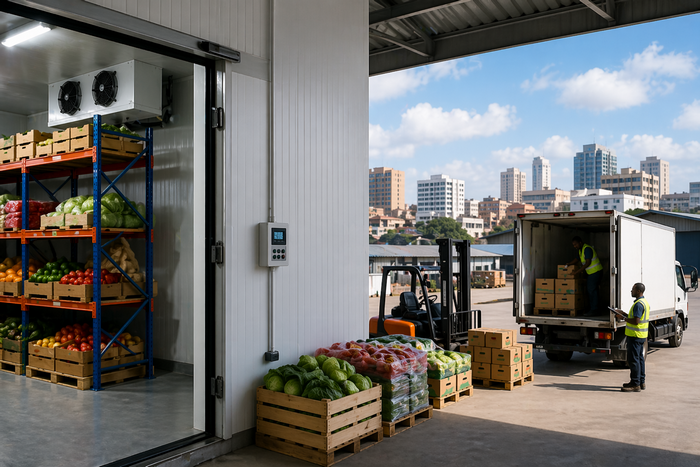
Table of Contents
- The Economic Importance of Zambia’s Retail and Food Distribution Sector
- The Cold Chain Gap: Where Losses and Inefficiencies Occur
- Why Cold Storage for Retail in Zambia Is a Strategic Investment
- How Our Modular Cold Rooms and Freezer Rooms Solve Real Industry Problems
- Product Overview: What We Offer Zambia’s Retail and Distribution Sector
- Economic Impact: How Reliable Cold Storage Strengthens Zambia’s Economy
- Practical Use Cases in Retail and Food Distribution
- Frequently Asked Questions
- Take the Next Step
The Economic Importance of Zambia’s Retail and Food Distribution Sector
Zambia’s retail and food distribution sector is not a side industry.
According to the Zambia Statistics Agency, Wholesale & Retail Trade accounts for 19.3 percent of GDP, with Transportation and Storage contributing 11.9 percent. That means almost a third of measurable economic output connects directly to moving, storing and selling goods.
When a sector this important suffers from inefficiencies, the impact ripples across the entire economy.
Now add perishable goods into the equation. Fresh produce, dairy, meat and frozen foods require controlled temperature environments from the moment they leave the farm until they reach the shelf. Without reliable cold storage for retail in Zambia, those goods deteriorate long before they reach the customer.
This is not theoretical. Research conducted in Lusaka’s urban food chains shows measurable food losses between harvest, transport and market stages. Those losses reduce profitability for retailers and undermine nutrition quality for consumers.
The solution is stronger cold chain infrastructure.
The Cold Chain Gap: Where Losses and Inefficiencies Occur
Where do the problems appear?
- Fresh produce arrives at wholesale markets without temperature control
- Distribution hubs lack adequate chilled storage capacity
- Retail back-of-house storage is undersized or inefficient
- Meat and dairy inventory experiences temperature fluctuation during peak demand
Each break in temperature control increases shrinkage, reduces shelf life and compresses margin.
If even 3 percent of inventory degrades before sale, profitability erodes fast. Multiply that across an industry representing nearly one fifth of GDP and the macro impact becomes clear.
Cold storage for retail in Zambia is infrastructure that protects economic value.
Why Cold Storage for Retail in Zambia Is a Strategic Investment
Cold storage influences four critical levers in Zambia’s retail and food distribution sector:
- Product Quality
- Shelf-Life Extension
- Operational Efficiency
- Supply Chain Stability
Stable temperatures preserve texture, taste and nutritional value.
Longer storage life improves stock rotation and reduces emergency discounting.
Properly engineered refrigeration reduces energy waste and prevents system overload.
Retailers and distributors can store larger volumes during supply disruptions.
When you improve cold storage reliability, you improve inventory predictability. When inventory becomes predictable, planning improves. When planning improves, investment confidence increases.
That is how infrastructure shapes economic resilience.
How Our Modular Cold Rooms and Freezer Rooms Solve Real Industry Problems
At Africhill, we do not just build cold rooms. We engineer high-performance modular cold storage solutions designed for maximum durability and efficiency.
Our modular approach is specifically suited to Zambia’s retail and food distribution sector because we design according to:
- Product type
- Daily throughput
- Required temperature
- Pull-down time
- Total storage mass
- Ambient conditions
Retailers do not operate identical facilities. A fresh produce distributor in Lusaka has different requirements to a meat wholesaler in the Copperbelt. That is why we customise every system.
What Makes Our Modular Construction Different
Our strong, thermal resistant modular and prefab panels form the backbone of every installation.
They are:
- Manufactured in-house
- Built using high-density EPS cores
- Bonded to Chromadek steel
- Approved against traditional safety and building standards
We control quality from manufacturing to installation. That consistency matters when your inventory depends on temperature stability.
Speed Matters in Retail
Time is money. A 9 m x 9 m modular cold or freezer room can be operational in as little as approximately 3 days. That short lead time allows you to expand quickly during peak season or respond to increased demand without long delays.
Neater, Quieter, Safer Installation
Cold rooms and freezer rooms are usually built inside warehouses, factories, shops, containers and structures. Our modular construction sites are neater, quieter and safer, reducing workplace disruption and safety risk.
Your operations continue. Your staff remain productive. Downtime stays minimal.
Energy Efficiency That Protects Margin
Our panels deliver excellent thermal insulation. That means strong temperature retention and improved energy efficiency throughout the year.
Electricity is one of the largest operational costs in cold storage. Efficient insulation reduces consumption and protects your operational budget.
Minimal Maintenance
Our cold rooms require less maintenance. That means you focus on retail performance and distribution logistics instead of ongoing repairs.
End-to-End or DIY
You can choose full installation by our team across Sub-Saharan Africa or assemble using your own contractor. We offer flexibility to match your operational capabilities.
From our factory in Kempton Park, Johannesburg, South Africa, we deliver modular cold and freezer rooms across Sub-Saharan Africa, including Zambia.
Product Overview: What We Offer Zambia’s Retail and Distribution Sector
We design modular cold storage specifically around the needs of Zambia’s Retail and Food Distribution Sector.
| PRODUCT | APPLICATION IN RETAIL & DISTRIBUTION | OPERATIONAL BENEFIT |
|---|---|---|
| Modular Cold Rooms | Fresh produce storage, dairy holding, back-of-house retail refrigeration | Stable 5°C to chilled environments, improved shelf life and stock rotation |
| Modular Freezer Rooms | Meat processing, frozen food distribution, bulk frozen storage | Stable -20°C environments, inventory protection and extended storage duration |
| Custom Refrigeration Capacity | Distribution hubs and high-throughput facilities | Engineered pull-down performance based on storage mass and throughput |
| Insulated Thermal Panels | All cold and freezer rooms | Energy efficiency, structural durability, minimal maintenance |
We have delivered cold storage solutions across Africa for:
- Retail and food distribution facilities
- Meat processors
- Fruit and vegetable retailers
- Dairy operations
- Agricultural storage facilities
Our 20 years of experience ensures we understand regional logistics, climate pressures and operational realities.
Economic Impact: How Reliable Cold Storage Strengthens Zambia’s Economy
When cold storage improves, Zambia’s retail and food distribution sector becomes more resilient.
Here is how that translates economically:
- Reduced Post-Harvest Loss
- Increased Investment Confidence
- Employment Stability
- Export Readiness
Cold storage is not just refrigeration. It is economic stabilisation infrastructure.
Practical Use Cases in Retail and Food Distribution
Experience Matters: Two Decades of Cold Storage Across Africa
For over 20 years, we have designed, manufactured and installed modular cold rooms and modular freezer rooms across Sub-Saharan Africa for sectors that directly mirror the needs of Zambia’s Retail and Food Distribution Sector.
Our experience includes:
- Retail and wholesale food distribution facilities
- Meat processing and frozen storage operations
- Fruit and vegetable cold storage
- Dairy production and chilled distribution
- Agricultural aggregation and packhouse environments
- And more
These environments demand precise temperature control, engineered pull-down capacity and durable insulated structures that perform consistently under commercial pressure.
We design every solution according to product type, storage mass, required temperature, throughput and ambient conditions to ensure operational reliability.
Because we manufacture our own high-density EPS insulated panels bonded to Chromadek steel, we maintain strict control over structural quality and thermal performance. This ensures long-term durability and minimal maintenance in demanding retail and distribution settings.
From our factory in Kempton Park, Johannesburg, South Africa, we deliver modular cold storage solutions across Sub-Saharan Africa, supporting growing retail and food distribution networks with engineered, high-performance infrastructure.
Frequently Asked Questions
What is the best cold storage solution for retail in Zambia?
The best solution is a customised modular cold room or freezer room engineered according to your product type, daily throughput and required temperature range.
How long does it take to install a modular cold room?
A 9 m x 9 m modular cold or freezer room can be operational in approximately 3 days, depending on site readiness.
What temperature can modular freezer rooms maintain?
We design freezer rooms for stable -18°C to -20°C environments and cold rooms for chilled conditions normally between 2 and 5°C, depending on your requirements.
Are modular cold rooms energy efficient?
Yes. Our insulated panels with high-density EPS cores provide strong thermal resistance, reducing electricity consumption.
Can cold storage be delivered outside South Africa?
Yes. We deliver modular cold and freezer rooms across Sub-Saharan Africa from our factory in Kempton Park, Johannesburg, South Africa.
Take the Next Step
Zambia’s retail and food distribution sector represents nearly one fifth of national GDP. It deserves infrastructure that protects value, reduces waste and supports growth.
We engineer modular cold rooms and freezer rooms that align precisely with your operational needs. We manufacture our own insulated panels. We customise refrigeration capacity. We deliver across Sub-Saharan Africa. We move quickly when time matters.
If you are serious about protecting your inventory, stabilising your margins and strengthening your role in Zambia’s retail and food distribution sector, speak to us.
Simply complete the enquiry form and let us design a modular cold storage solution built for your business, your products and your future.
<3>Sources Consulted
Zambia Statistics Agency Monthly Bulletin
Volume 261 of 2024 – The Monthly (December)
Publisher: Zambia Statistics Agency (ZamStats)
Summary: This official national accounts bulletin provides Zambia’s GDP distribution by industry and reports that Wholesale & Retail Trade accounts for 19.3% of GDP, with Transportation and Storage contributing 11.9%, highlighting the economic importance of Zambia’s Retail and Food Distribution Sector.
https://www.zamstats.gov.zm/wp-content/uploads/2024/12/Vol-261-of-2024-The-Monthly-December.pdf
Managing Food Value Chains for Improved Nutrition for Urban Vulnerable Populations in Lusaka City (Zambia)
Final Report (AfricitiesFood Project)
Publisher: Australian Centre for International Agricultural Research (ACIAR)
Summary: This research report analyses food value chains in Lusaka and documents measurable post-harvest losses occurring between harvest, transport and urban market stages. It highlights inefficiencies in cold chain and storage infrastructure and their impact on food quality, profitability and nutrition outcomes.
https://www.aciar.gov.au/sites/default/files/2023-12/cs-2020-210-final-report.pdf
Zambia National Pathway for Food Systems Transformation
National Food Systems Pathway Document (21 July 2023)
Publisher: UN Food Systems Coordination Hub
Summary: This national pathway outlines Zambia’s strategy for strengthening food value chains, reducing post-harvest losses and improving food system resilience. It reinforces the policy importance of infrastructure improvements across retail and distribution systems.
https://www.unfoodsystemshub.org/docs/unfoodsystemslibraries/national-pathways/zambia/2023-07-21-zambia-national-pathway—english.pdf
Quarterly Survey of Business Opinion and Expectations (Q1 2025)
Business Conditions Report
Publisher: Bank of Zambia
Summary: This survey provides insight into prevailing business conditions, including inflationary pressure, exchange rate volatility and constrained access to credit. These macroeconomic factors directly affect Zambia’s Retail and Food Distribution Sector and reinforce the importance of operational efficiency and waste reduction.
https://www.boz.zm/QSBOEQ12025ReportFinal_.pdf