
Cold Storage Raising Zambia’s Agricultural Productivity & Food Security
- What Zambia Needs to Improve Productivity & Security
- Why Zambia’s Agricultural Sector Matters to the Economy
- The Productivity Problem Nobody Talks About Enough
- Food Security Pressure: What the Latest Drought Data Really Shows
- Where Modular Cold Storage Fits into Zambia’s Value Chains
- Why Modular Construction Works Better for Agriculture
- Africhill’s Modular Solutions for Zambian Agriculture
- Practical Examples: How Cold Storage Improves Outcomes Across Key Crops
- The Bigger Economic Impact
- FAQ
- A Stronger Food System Starts with the Right Cold Storage
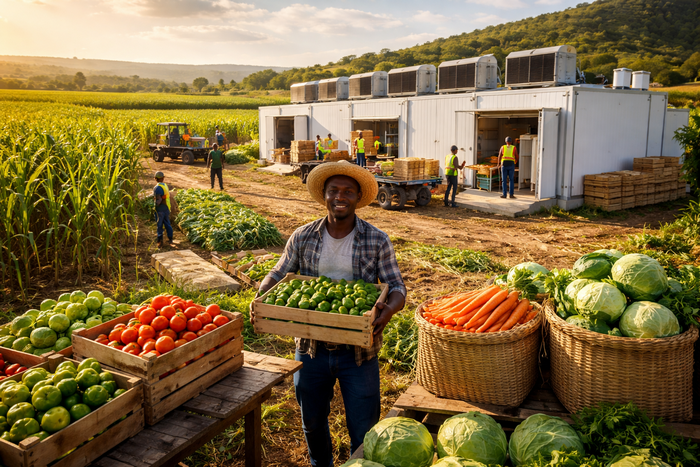
What Zambia Needs to Improve Productivity and Food Security
Zambia can improve agricultural productivity and strengthen food security by protecting what it already produces, and modular cold storage is one of the fastest, most practical ways to do it.
When perishables spoil between farm, packhouse, processor, and market, productivity drops even if yields look good on paper. Cold storage turns that around by extending shelf life, stabilising supply, and creating room for value addition.
Recent drought impacts show why this matters right now. In Zambia’s 2023/24 season, only 31% of the 2.2 million hectares planted to maize was harvested, and the shock affected 9.8 million people, with 6.6 million facing severe food insecurity. Those are not abstract numbers. They are a warning sign that every tonne preserved, stored, and distributed efficiently matters. (World Bank)
That is where modular cold rooms and modular freezer rooms become economic infrastructure, not just equipment.
At Africhill, we don’t just build cold rooms, we engineer high-performance modular cold storage designed for durability and efficiency, so you can reduce losses, keep quality consistent, and build a supply chain that holds up under pressure.
Why Zambia’s Agricultural Sector Matters to the Economy
Agriculture is a pillar sector in Zambia, even when different institutions describe its GDP contribution in different ways.
On the one hand, Zambia’s Development Agency sector profile notes agriculture contributed 2.8% of GDP in 2023 and employs about 70% of the population. That framing typically reflects a narrower formal measurement of sector output. (ZDA)
On the other hand, regional economic briefs highlight the broader reality that agriculture supports livelihoods at scale and can contribute up to 20% of GDP, with over 50% of the population employed across farming, related services, and rural value chains. (AKADEMIYA2063)
Different numbers, same message. Agriculture touches almost every household economy and remains central to growth, jobs, and food access.
That is also why climate shocks ripple so quickly through the national system, and why food security in Zambia cannot improve sustainably without investing in resilience across the entire value chain.
Cold storage is one of the most direct resilience investments you can make, because it reduces loss, improves quality, and strengthens distribution at the exact point where agriculture often fails: after harvest.
The Productivity Problem Nobody Talks About Enough: Loss After Harvest
Zambia can grow more and still lose more.
Productivity is not only about yield per hectare. It is also about how much of your output reaches consumers in good condition, and how much value you retain per kilogram.
Across African countries, postharvest losses for fresh produce are often estimated in the range of 20% to 40% of total production, depending on crop type, handling, storage, and transport. (Emerald)
That range is where profits disappear.
Think about what that means in real business terms:
- You spend money to plant, irrigate, fertilise, and harvest
- You pay to pack, transport, and market
- Then you lose part of the product before it generates revenue
Cold storage does not just “keep things cool”. It protects margin, stabilises operations, and changes the structure of the business.
And when drought tightens supply, waste becomes even more expensive. That is why cold storage links directly to Agricultural Productivity and Food Security in Zambia.
Food Security Pressure: What the Latest Drought Data Really Shows
Zambia’s food security challenge is not theoretical. It is measurable, recent, and severe.
During the 2023/24 agricultural season, El Niño conditions contributed to major crop losses. Government and analysis partners reported maize destruction on the order of nearly 1 million hectares, representing about 40% of the land under maize production. (AKADEMIYA2063)
At a national level, the World Bank’s drought-linked assessment noted that only 31% of planted maize area was harvested, and that the drought affected 9.8 million people, with 6.6 million facing severe food insecurity. (World Bank)
Food insecurity projections also remain high. The IPC analysis projected 5.8 million people would likely face heightened acute food insecurity between October 2024 and March 2025, with millions expected in Crisis levels. (IPC)
FAO’s impact assessment further underlined production pressure, including estimates placing the drought-affected maize harvest around 1.76 million tonnes in 2024. (FAO)
These are the moments when cold storage shifts from “nice to have” into “must have” because supply is tight, prices fluctuate, and every unit wasted becomes a direct hit to food availability and farm income.
Where Modular Cold Storage Fits into Zambia’s Real-World Value Chains
To make this practical, let’s follow the path of food.
Farm to Aggregation
Smallholder and commercial farms move produce to aggregation points. Without modular cold rooms at these points, soft fruit, vegetables, and dairy start deteriorating immediately.
Aggregation to Packhouse or Processor
Transport delays and heat exposure reduce quality further. If your packhouse has modular cold storage, you can slow the decline and protect grading outcomes.
Processing and Distribution
Agro-processing works best when inputs arrive consistently. Modular freezer rooms allow processors to stabilise supply and manage throughput.
Retail and Export
Export markets demand quality consistency. Cold storage helps you meet buyer expectations and reduce rejection risk.
Cold storage does not fix every challenge in the system. But it fixes one of the costliest ones: avoidable loss.
Why Modular Construction Works Better for Agriculture
Zambia’s agricultural sector does not operate on slow timelines. Harvest windows are short. Supply surges are seasonal. Drought shocks change plans overnight.
Modular cold storage matches agricultural reality.
Fast, predictable installation
Our short manufacturing lead times and fast construction times mean a simple 9m x 9m modular cold or freezer room can be operational in as little as +-3 days. When time is money, speed is productivity.
Scalable infrastructure
You can add capacity as production grows. You can start with a modular cold room for one product line, then expand into multiple zones or add freezer space as your business evolves.
Lower disruption
Cold rooms and freezer rooms are usually built inside warehouses, factories, shops, containers and structures. Our modular construction sites are neater, quieter and safer, reducing disruption and safety risks.
In agriculture, downtime costs more than most people realise. Modular builds reduce that downtime.
Africhill’s Modular Cold Rooms and Freezer Rooms for Zambian Agriculture
At Africhill, we don’t just build cold rooms, we engineer high-performance cold storage solutions designed for maximum durability and efficiency.
Here is what that looks like for Zambia’s agricultural needs.
- Tailored solutions that understand local industry challenges
We have manufactured and installed a wide range of cold room solutions across Africa. That experience helps us design modular cold rooms and freezer rooms around the operational realities you face. - Highly customised solutions
We can provide exactly what you require, from industrial cold rooms to DIY and mobile refrigeration solutions. Our in-house expert engineers sign off unique requirements so your operational needs are met with minimal compromise. - Fast manufacturing and installation
A simple 9m x 9m room can be operational in as little as +-3 days. This is ideal for tight schedules where delays mean losses. - Neater, safer builds inside existing structures
Cold rooms and freezer rooms are usually built inside warehouses, factories, shops, containers and structures. Modular construction reduces disruption. - Excellent durability and long-term reliability
We use quality materials and manufacture insulated thermal panels to high standards, approved against the same standards as traditional building materials. You get long-term reliability with minimal maintenance. - In-house panel manufacturing
Africhill panels are manufactured in-house using high-density EPS cores bonded to Chromadek steel and approved against traditional safety and building standards. - Low maintenance
Our cold rooms require less maintenance, allowing you to focus on your core operation. - Superb service
Our best practices have been honed over 20 years of experience. You get expert advice and support at every stage. - End-to-end solutions or DIY
You can choose to erect the structure with local help, or our agents across Sub-Saharan Africa can deliver a completed project, including custom fittings and trimmings. - Refrigeration capacity designed to requirement
Africhill designs cold and freezer rooms and refrigeration capacity according to the client and product requirements. Whether you need blast chilling or stable -20 to 8°C environments, we design for your use case. - Delivery across Sub-Saharan Africa
We can deliver your modular cold and freezer room anywhere in Sub-Saharan Africa from our factory in Kempton Park, Johannesburg.
The highly effective insulation built into our panels supports year-round energy savings and helps you reduce operating costs.
Practical Examples: How Cold Storage Improves Outcomes Across Key Crops
Fresh produce and horticulture
You harvest. Heat hits. Quality drops fast. A modular cold room at your packhouse protects grading outcomes, slows spoilage, and gives you control over when you sell.
Dairy collection and processing
Milk quality depends on rapid cooling. Modular cold rooms help stabilise temperature control at collection or processing points, improving consistency and reducing waste.
Meat and fish value chains
Freezer rooms extend storage windows, allowing processors and distributors to manage throughput, reduce emergency selling, and meet supply contracts more consistently.
Agro-processing inputs
When processors lose inputs to spoilage, they lose production time and revenue. Modular cold storage stabilises raw material availability and supports predictable operations.
The Bigger Economic Impact: From Farmer Income to National Resilience
When cold storage reduces waste, it directly increases effective supply. When effective supply rises, food access improves. When food access improves, price pressure eases. When prices stabilise, households cope better.
This is why cold storage becomes an economic tool, not just an operational upgrade.
Zambia’s recent drought showed how quickly the system can tighten. With millions facing acute food insecurity and major crop losses recorded, food system resilience has become a national priority. (World Bank, IPC, AKADEMIYA2063)
Modular cold storage helps resilience by protecting food value chains when conditions are volatile.
And when conditions improve, cold storage also supports growth by enabling agro-processing, export readiness, and more stable supply systems.
FAQ
What is agricultural cold storage used for in Zambia?
Agricultural cold storage is used to preserve fresh produce, dairy, meat, and fish by maintaining controlled temperatures after harvest or processing, reducing spoilage and protecting quality.
How does cold storage improve food security?
Cold storage reduces losses, stabilises supply, and helps food reach consumers in good condition. That strengthens availability and price stability, especially during tight seasons.
What is the difference between a cold room and a freezer room?
A cold room typically supports chilled storage, often around +2°C depending on product. A freezer room supports lower temperatures, typically around -18°C depending on use case.
Why does modular cold storage matter for agriculture?
Modular cold storage installs faster, scales easier, and fits inside existing structures. That makes it more practical for farms, packhouses, processors, and aggregation hubs.
A Stronger Food System Starts with the Right Cold Storage
Zambia’s agricultural sector has massive potential. But productivity does not end at harvest. It ends when food reaches people in good condition, at a fair price, with minimal loss.
Modular cold storage is one of the most direct ways to increase Agricultural Productivity and Food Security in Zambia because it protects quality, reduces waste, and stabilises supply chains.
At Africhill, we engineer modular cold rooms and modular freezer rooms designed for durability, efficiency, and African operating realities. We customise your system to your product, volumes, and temperatures. We manufacture our panels in-house. We deliver across Sub-Saharan Africa.
If you want to reduce loss, improve value chain performance, and strengthen food security outcomes, complete the enquiry form and let us design the right modular cold storage solution for your operation.
Sources Consulted
First Zambia Climate and Economic Resilience Programmatic Development Policy Financing with a Catastrophe Deferred Drawdown Option
Program Document (P507116)
Publisher: The World Bank
Summary: Provides drought impact figures, including that only 31% of 2.2 million hectares of planted maize was harvested, and that the drought affected 9.8 million people with 6.6 million facing severe food insecurity.
https://documents1.worldbank.org/curated/en/099112524175539911/pdf/BOSIB15d0cfc7e05818c2a1636531983275.pdf
Zambia: IPC Acute Food Insecurity Analysis
July 2024 – March 2025
Publisher: IPC Global Partnership
Summary: Provides projections of acute food insecurity, including the estimate that 5.8 million people would likely experience heightened hunger between October 2024 and March 2025.
https://www.ipcinfo.org/fileadmin/user_upload/ipcinfo/docs/IPC_Zambia_Acute_Food_Insecurity_Jul2024_Mar2025_Report.pdf
Impacts of El Niño-Induced Drought in Zambia
El Niño Effects in Southern Africa Series No. 3
Publisher: AKADEMIYA2063
Summary: Reports that drought destroyed nearly 1 million hectares of maize, about 40% of maize land, and provides context on agriculture’s employment and GDP relevance in Zambia.
https://akademiya2063.org/publications/El-Nino%20Effects%20in%20Southern%20Africa/El-Nino%20Effects%20in%20Southern%20Africa%20Series%20No.3.pdf
Zambia: El Niño impact assessment highlights
Impact Assessment Highlights (July 2024)
Publisher: Food and Agriculture Organization of the United Nations (FAO)
Summary: Provides drought and production context, including estimates on the 2024 maize harvest level and impacts on agricultural output.
https://openknowledge.fao.org/handle/20.500.14283/cd3216en
Agriculture Sector Profile 2024
ZDA Agriculture Sector Profile
Publisher: Zambia Development Agency (ZDA)
Summary: Provides sector profile data, including agriculture contribution to GDP (2.8% in 2023) and employment estimate (about 70% of the population).
https://www.zda.org.zm/wp-content/uploads/2024/09/ZDA-Agriculture-Sector-Profile-2024-Final.pdf
Minimization of losses in postharvest of fresh produce supply chains
Journal article (December 2024)
Publisher: Emerald Publishing
Summary: Notes common African postharvest loss estimates for fresh produce supply chains, including ranges between 20% and 40% of total production in many contexts.
https://www.emerald.com/jadee/article/16/2/364/1251526/Minimization-of-losses-in-postharvest-of-fresh