
Cold Storage Upgrading Uganda’s Fisheries and Meat Processing Industry
Table of Contents
- Why Cold Storage Is Now Essential for Uganda
- The Economic Weight of Fisheries and Meat Processing
- Market Trends Reshaping Uganda’s Protein Supply Chains
- Where the Industry Is Struggling Today
- How Cold Storage Changes the Economics
- Africhill’s Cold & Freezer Rooms Built for Uganda
- Africhill Products Supporting Fisheries and Meat Processing
- Proven African Experience That Reduces Risk
- What Opportunities Open Up with Proper Cold Storage
- Frequently Asked Questions
- Take the Next Step with Africhill
Why Cold Storage Is Now Essential for Uganda
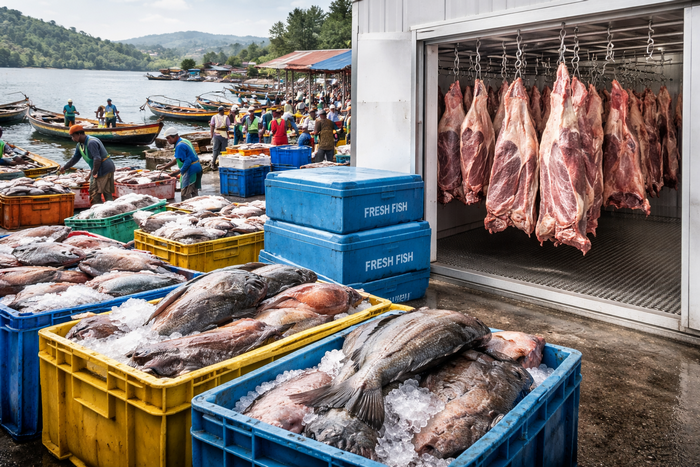
Cold storage is no longer a secondary consideration for Uganda’s fisheries and meat processing industry. It is a deciding factor between growth and stagnation.
Uganda’s fisheries sector alone produces an estimated 625,000 tonnes of fish annually, generating approximately UGX 2 trillion in value. That contribution translates into around 3 percent of national GDP and 12 percent of agricultural GDP, making fisheries one of the country’s most economically significant food industries. Meat processing is following a similar upward path as demand for animal protein rises across urban and regional markets.
Yet despite this growth, a large portion of that value is lost before products reach consumers. The reason is simple. Production has expanded faster than the infrastructure needed to preserve quality.
At Africhill, we design cold storage solutions that directly address this gap. Our modular cold rooms and freezer rooms allow fisheries and meat processors to protect product value, reduce losses, and participate more confidently in formal and export markets.
The Economic Weight of Fisheries and Meat Processing
Fisheries and meat processing are not niche industries in Uganda. They are central to livelihoods, food security, and economic stability.
Fish alone provides a primary source of protein for roughly 15 million people, while also supporting millions of jobs across fishing, processing, transport, and trade. Export earnings from fish and fish products continue to feature prominently among Uganda’s non-regional exports, reinforcing the sector’s importance to foreign exchange inflows.
On the meat side, government and development programmes are actively encouraging improved slaughtering, processing, and handling standards. These efforts aim to move the sector away from informal, low-value sales toward structured value chains that can meet domestic demand and regional trade requirements.
As Uganda’s economy recorded growth of over 6 percent in the most recent financial year, agriculture, forestry, fishing, and agro-processing were among the key drivers. This growth increases production volumes, but it also raises the stakes. Without cold storage, higher output simply leads to higher losses.
Market Trends Reshaping Uganda’s Protein Supply Chains
Several trends are shaping how fisheries and meat processing operate in Uganda today.
Growing Demand for Quality and Consistency
Urbanisation and population growth are increasing demand for fish and meat products that are safe, consistent, and professionally handled. Buyers are no longer just purchasing volume. They are purchasing quality.
Formalisation of Value Chains
There is a clear shift toward structured supply chains, particularly in meat processing. Slaughter facilities, processors, and retailers are under pressure to improve hygiene, traceability, and temperature control.
Export Market Sensitivity
Export markets reward reliability and penalise inconsistency. Even short breaks in cold storage can compromise entire consignments, turning potential export revenue into waste.
Investment into Livestock and Fisheries
Long-term development projects targeting livestock and fisheries value chains signal sustained growth ahead. As production increases, the demand for cold rooms and freezer rooms grows alongside it.
These trends all point to one conclusion. Cold storage is becoming core infrastructure, not optional equipment.
Where the Industry Is Struggling Today
Despite positive momentum, several challenges continue to limit profitability.
High Post-Harvest and Post-Slaughter Losses
Fish and meat are among the most perishable products in the food system. Without immediate chilling, spoilage accelerates. Losses occur before processing even begins.
Inconsistent Temperature Control
Many operators rely on ad-hoc cooling or insufficient storage capacity. This forces quick sales at reduced prices and limits flexibility.
Bottlenecks During Peak Supply
Seasonal peaks in fish landings or livestock supply overwhelm facilities without adequate cold storage. Excess product cannot be held safely and is often discarded.
Restricted Market Access
Poor handling and inconsistent storage reduce access to formal buyers and export markets that demand reliable temperature control.
These challenges are structural, not operational. They require infrastructure solutions, not short-term fixes.
How Cold Storage Changes the Economics
Cold storage does more than preserve products. It reshapes how value is created.
Cold rooms allow fish and meat to be chilled immediately after landing or slaughter, slowing bacterial growth and stabilising quality. Freezer rooms extend storage windows, allowing processors to match supply with demand rather than selling under pressure.
With effective cold storage, businesses can:
- Reduce waste and spoilage
- Hold product until market conditions are favourable
- Improve consistency and buyer confidence
- Expand into value-added processing
- Plan distribution more efficiently
This is where Africhill’s solutions deliver measurable impact.
Africhill’s Cold & Freezer Rooms Built for Uganda
At Africhill, we don’t just build cold rooms. We engineer cold storage solutions around real operational needs.
Tailored to Local Challenges
We have manufactured and installed cold room solutions across multiple African countries, giving us practical insight into the challenges faced by fisheries and meat processors in the region. Our designs reflect local conditions, workflows, and growth patterns.
Highly Customised Solutions
Every Africhill cold room or freezer room is designed around your requirements. From industrial-scale installations to mobile refrigeration solutions, our in-house engineers approve each system to ensure it meets your operational needs with minimal compromise.
Fast Manufacturing and Installation
Time matters when product is perishable. Our short manufacturing lead times mean a 9m x 9m cold or freezer room can be operational in approximately three days, allowing businesses to respond quickly to demand or expansion.
Modular Construction That Minimises Disruption
Africhill cold rooms are built inside warehouses, factories, shops, containers, and existing structures. This modular approach creates neater, quieter, and safer construction sites with minimal disruption to daily operations.
Energy-Efficient Performance
Our insulated panels provide strong thermal resistance, helping maintain stable internal temperatures while supporting lower energy consumption over time.
Quality and Durability by Design
We design and manufacture our own insulated thermal panels using quality materials. These panels are built to deliver long-term reliability with minimal maintenance.
In-House Panel Manufacturing
Africhill panels are manufactured in-house using high-density EPS cores bonded to Chromadek steel, ensuring structural strength and dependable insulation performance.
Low Maintenance Operation
Our cold rooms require very little ongoing maintenance, allowing operators to focus on production rather than infrastructure issues.
Flexible Delivery Options
Whether you choose a DIY installation or full project delivery, our team and agents across Sub-Saharan Africa can support you from start to finish.
Africhill Products Supporting Fisheries and Meat Processing
Africhill provides a complete cold storage ecosystem:
| Application | Africhill Solution |
|---|---|
| Fish landing and aggregation | Modular cold rooms |
| Fish export preparation | Freezer rooms |
| Carcass chilling | Cold rooms |
| Meat storage and dispatch | Freezer rooms |
| Rapid temperature reduction | Blast chilling and freezing |
| Structural insulation | Insulated panel systems |
| Refrigeration control | Condensing units |
| Integrated processing | Refrigeration rooms |
Each component is designed to work together, creating a reliable cold storage environment.
Proven African Experience That Reduces Risk
Cold storage performance directly affects income and reputation. Experience matters.
Africhill has delivered cold storage solutions for fisheries, meat processing, dairy, and food operations across Africa, including meat processing shops and fisheries-related cold storage applications. This experience reduces risk for businesses investing in long-term infrastructure.
What Opportunities Open Up with Proper Cold Storage
Cold storage does not just solve current problems. It unlocks future growth.
Higher Retained Value
Reducing spoilage means more of each kilogram produced is sold at full value.
Stronger Export Readiness
Consistent temperature control improves compliance with export buyer expectations.
Expansion into Value-Added Products
Freezer rooms enable portioning, packaging, and frozen product lines.
Greater Investment Appeal
Businesses with reliable cold storage infrastructure are better positioned for partnerships and funding.
Frequently Asked Questions
Why is cold storage important for fisheries in Uganda?
It preserves quality, reduces spoilage, and supports access to higher-value markets.
How does cold storage support meat processing?
Cold rooms and freezer rooms stabilise supply, improve consistency, and extend shelf life.
Can Africhill deliver cold storage solutions to Uganda?
Yes. Africhill delivers modular cold and freezer rooms across Sub-Saharan Africa, including Uganda.
How fast can a cold room be installed?
A standard 9m x 9m Africhill cold or freezer room can be operational in about three days.
Take the Next Step with Africhill
Uganda’s fisheries and meat processing industries are growing. The businesses that succeed will be those that protect quality and reduce loss.
If you are looking for cold storage for fisheries in Uganda, cold storage for meat processing in Uganda, or cold and freezer rooms for meat, Africhill is ready to help.
Complete the enquiry form and let us design a cold storage solution that protects your product and supports long-term growth.
Sources Consulted:
Uganda National Plan of Action for Implementation of the Voluntary Guidelines for Securing Sustainable Small-Scale Fisheries
National Plan of Action for Small-Scale Fisheries (NPOA-SSF), Uganda
Publisher: Food and Agriculture Organization of the United Nations (FAO) / Ministry of Agriculture, Animal Industry and Fisheries (MAAIF), Uganda
Summary: This national plan outlines the economic importance of Uganda’s fisheries sector, estimating fish production at approximately 625,000 tonnes valued at UGX 2 trillion, contributing around 3% to national GDP and 12% to agricultural GDP. It highlights structural challenges in handling, value chains, and infrastructure that limit value retention and growth.
https://www.fao.org/fileadmin/user_upload/ssf/documents/npoa_uganda.pdf
Performance of the Economy Report – August 2024
Performance of the Economy: Merchandise Exports (Including Fish and Fish Products)
Publisher: Ministry of Finance, Planning and Economic Development (MoFPED), Republic of Uganda
Summary: This report provides up-to-date economic and trade data, including export performance for fish and fish products. It demonstrates the ongoing contribution of fisheries to Uganda’s export earnings and highlights volatility that underscores the importance of proper handling and cold storage infrastructure.
https://mepd.finance.go.ug/documents/POE/2024/POE-2024-08-AUG.pdf
Macroeconomic and Fiscal Performance Report FY 2023/24
Uganda Macroeconomic and Fiscal Performance Report
Publisher: Ministry of Finance, Planning and Economic Development (MoFPED), Republic of Uganda
Summary: This report details Uganda’s recent economic performance, noting GDP growth of over 6% in FY 2023/24. It identifies agriculture, forestry, fishing, and agro-processing as key contributors to growth, providing context for rising production volumes and increased infrastructure needs such as cold storage.
https://mepd.finance.go.ug/documents/MFP/MFP-FY202324.pdf
Beef Value Chain Situation Analysis for Uganda
Beef Value Chain Situation Analysis
Publisher: CGIAR / International Livestock Research Institute (ILRI)
Summary: This analysis examines Uganda’s beef value chain from production to retail, identifying bottlenecks such as limited processing infrastructure, handling inefficiencies, and fragmented cold chain capacity. It provides context for the need for improved chilling, storage, and distribution systems in meat processing.
https://cgspace.cgiar.org/bitstreams/e41c2b05-dd0c-45b7-854f-e7b8b2ababef/download
Resilient Livestock Value Chain Project (ReLIV) – Uganda
EB 2024/142/R.8 – Uganda: Resilient Livestock Value Chain Project
Publisher: International Fund for Agricultural Development (IFAD)
Summary: This project document outlines long-term investment (2024–2032) in Uganda’s livestock value chains, including meat production and processing. It emphasises value addition, improved marketing, and infrastructure development, signalling future growth and increased demand for cold storage solutions.
https://webapps.ifad.org/members/eb/142/docs/EB-2024-142-R-8.pdf
Cold Chain Storage Market Assessment 2023
Cold Chain Storage Market Assessment for Key Ugandan Value Chains
Publisher: Energy and Environment Partnership (EEP Africa)
Summary: This assessment identifies Ugandan value chains with strong business cases for cold storage investment, including fisheries. It highlights how cold storage can reduce waste, improve quality, and unlock higher-value markets, reinforcing the commercial relevance of modular cold storage solutions.
https://eepafrica.org/documents/Sector-Briefs/cold-chain-storage-market-assessment-2023.pdf